
Worcester's 2028 abolition is on hold under a government review. Consultation on a new City of Worcester Council now opens 29 October, not 1 October.
The plan to abolish Worcester City Council on 1 April 2028 is on hold. The government has paused reorganisation in Worcestershire while it reviews the whole programme, and it has given no date for an answer.
The pause has already slowed the city’s own plan for what replaces it. That plan is a new town council for Worcester, provisionally called the City of Worcester Council. Its public consultation was due to open on 1 October. Councillors were asked on Tuesday to push that back to 29 October.
What the government decided, and then paused
On 16 July the government chose to replace all seven Worcestershire councils with two unitary councils from 1 April 2028. Worcester, Malvern Hills and Wychavon would form South Worcestershire Council. Bromsgrove, Redditch and Wyre Forest would form North Worcestershire Council. (Worcestershire: Local government reorganisation, GOV.UK)
On 7 September the government announced a review of the programme. Decisions for Essex, Hampshire, Norfolk and Suffolk were withdrawn outright. The plans for 14 other areas, which include the July decisions, are “being reviewed and paused”. (Review of local government reorganisation launched, GOV.UK, 7 September 2026)
The minister, Jim McMahon, wrote to council leaders the same day. He asked them to “cease work on implementing the decisions that were announced in July” until the review is over. He also said elections due in May 2027 “will go ahead to existing council boundaries”. (Letter to council leaders, Ministry of Housing, Communities and Local Government, 7 September 2026)
That matters here because the old timetable had shadow elections to the new South Worcestershire authority on 6 May 2027. The letter does not say what happens to those.
Worcester City Council has added a note to its reorganisation page. It says it is “seeking clarification on what this means for Worcestershire” and that “there will be no immediate change to the services people receive”. The rest of the page still sets out the 2028 timetable underneath. (Local Government Reorganisation, Worcester City Council)
The parish council plan it knocks sideways
The city council started a Community Governance Review in February. It did so because it expected to be abolished, and wanted to decide what local body, if any, should be left behind.
The first public consultation ran in May and June and drew 916 responses. The July report to Council records that:
- 76% wanted a parish or town council
- 59% said they would be willing to pay a precept
- 62% did not think the new unitary arrangements would meet their needs
- 68% of respondents lived in an area that already has a parish council, and 29% in the unparished area
(Community Governance Review report, Council, 14 July 2026)
That last figure is worth reading twice. Worcester has only two parish councils, Warndon Villages and St Peter the Great. The new council would cover everywhere else, yet most people who answered already live under a parish council.
On 14 July councillors backed Option 1 as the preferred option: one new town or parish council for the currently unparished part of the city, with the two existing parishes left as they are. (Minutes, Council, 14 July 2026)
The details that were to go out for consultation are:
| Proposal | Detail |
|---|---|
| Name | City of Worcester Council |
| Councillors | 17, across 9 wards |
| Wards | Battenhall, Bedwardine, Claines, Nunnery, Rainbow Hill and Fort Royal, Riverside, St John, St Stephen, Warndon and Elbury Park |
| Elections | Every four years |
| Estimated precept | £60 to £100 a year for a Band D home |
The wards follow the current county council divisions. Battenhall would elect one councillor, because it is about half the size of the others. The council says the precept can only be an estimate, because nobody yet knows which services the new body would run. Every household was to receive a booklet explaining the preferred option, which the working group said would help “preserve the mayoralty and city status”. (Community Governance Review report, Audit and Governance Committee, 16 September 2026)
The new timetable
Officers stopped work on the review the week the pause was announced. The councillors’ working group met on Monday 14 September and chose not to stop altogether. Its reasoning was that the government could still confirm the original dates, and the city needs to be ready for May 2027 if it does.
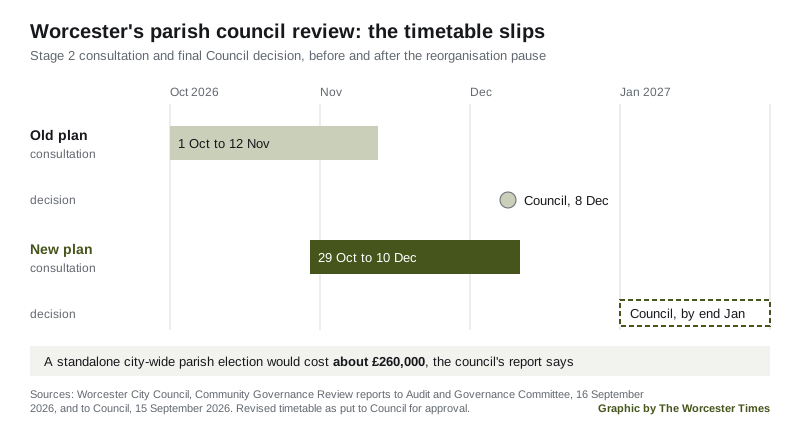
The revised dates put to Council on Tuesday are:
- stage 2 consultation opens on 29 October instead of 1 October
- it closes on 10 December instead of 12 November
- the working group considers the results in December and January
- Council decides before the end of January 2027, instead of at an extraordinary meeting on 8 December
(Community Governance Review: revised timetable, Council, 15 September 2026)
The Monitoring Officer advised that the review would realistically need to finish by February 2027. If the reorganisation is still unclear by then, the council could reach its conclusion and leave the start date for any new parish council open. The report also warns that if the review stalls for more than 12 months, “it may begin to lose its overall credibility”.
The £260,000 question
The working group noted a good level of support for a parish council “on the understanding that Worcester City Council is to be abolished”. That condition is now the thing in doubt.
It also agreed that a standalone city-wide parish election would not be good value. The report puts the cost “in the region of £260,000”. So any new parish council would be elected alongside other elections, whether shadow authority or district council polls, rather than on a date of its own.
Other plans built on 2028
The review is not the only city business that assumed a 2028 end date. On 1 September the Policy and Resources Committee considered leasing 28 spaces at Cattlemarket Car Park to the county for a new sixth form. The county pays an upfront premium for lost parking income up to 1 April 2028. If the new unitary councils do not arrive on that date, a rent becomes payable instead, which the council’s parking team puts at around £60,000 a year. (Lease of part of Cattlemarket Car Park, Policy and Resources Committee, 1 September 2026) We covered that deal in our Cattlemarket report.
What it means for you
- Nothing changes to your services now. Bins, council tax, parking and planning are still run by Worcester City Council, and you contact it in the usual way.
- Your council tax bill is not affected yet. A parish precept only arrives if a new council is created. The £60 to £100 Band D figure is an early estimate, not a charge. Our Worcester council tax bands page has what you pay today.
- Watch for the booklet. If the new timetable is approved, the stage 2 consultation opens on 29 October and every household is due a booklet. You can comment on the whole proposal or on single parts of it, such as the name, the wards or the precept.
- The 2028 date is not settled. Treat anything that says Worcester City Council ends on 1 April 2028 as a plan under review, including on this site, until the government reports.
Council met on Tuesday 15 September to vote on the revised timetable. Its minutes will not be published until they are approved at the next meeting. We will report the outcome of the government review when it lands, and the stage 2 consultation when it opens.
Have your say