
Worcester's city centre logged 11 noise complaints in three months, 1.48 per 1,000 people and second highest in Worcestershire. Five city areas make the list.
Worcester’s city centre generated more noise complaints per head between April and June than anywhere in Worcestershire except one town in Wyre Forest.
The figures are in a report going to the Worcestershire Regulatory Services Board on Thursday. WRS handles environmental health for all six district councils, including Worcester City Council, and its quarterly activity report maps noise complaints to small neighbourhoods for the first time this year. (Public WRS Board pack, 24 September 2026, Worcestershire Regulatory Services Board)
The report lists the 21 neighbourhoods in the county with the highest rate of noise complaints per 1,000 people. Five of them are in Worcester.
The five Worcester areas on the list
| Area | County rank | Complaints | Population | Rate per 1,000 |
|---|---|---|---|---|
| Worcester Town South | 2nd | 11 | 7,424 | 1.48 |
| Dines Green and St John's | 4th | 11 | 8,528 | 1.29 |
| St Peter's | 14th | 5 | 5,275 | 0.95 |
| Northwick | 20th | 6 | 7,920 | 0.76 |
| Warndon West | 21st | 4 | 5,385 | 0.74 |
Worcester Town South is the statistical area covering the city centre around the Cathedral and Sidbury. Only Stourport Mitton and Wilden, in Wyre Forest, had a higher rate, at 2.26 per 1,000 from 18 complaints.
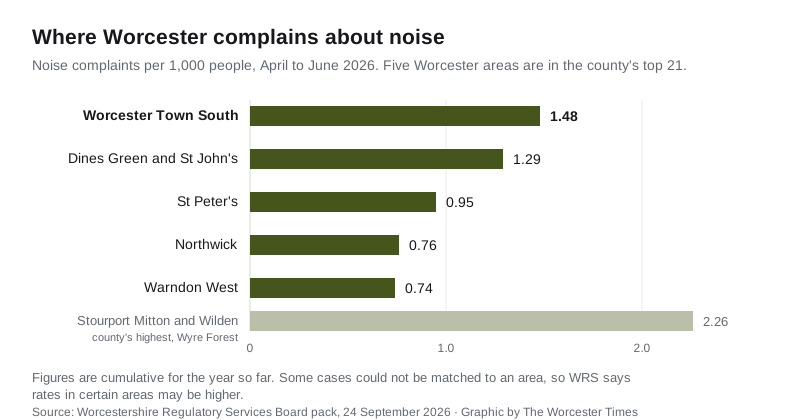
Two warnings come with the table, and they are the report’s own. The figures are cumulative, so they cover the year so far and will keep changing until the annual report. And some cases could not be matched to a neighbourhood at all, so WRS says “the rates in certain areas may be higher”.
Half of it is dogs and neighbours, not pubs
The obvious assumption about a city-centre noise figure is the night-time economy. The report says it is only part of the picture.
Across the county, around half of noise complaints relate to noise from domestic properties, with barking dogs and audio-visual equipment the most common causes. A significant proportion do come from the hospitality sector, primarily music or people at pubs and clubs. The rest of the nuisance workload is smoke from burning domestic or commercial waste, and noise or dust from construction sites.
Pollution work as a whole is rising sharply. WRS logged 556 pollution cases in the first quarter of this year, against 553 at the same point last year and 334 the year before that. Around 90 per cent of pollution cases are nuisance reports, and most of those are about noise.
The service also says its nuisance team was “extremely busy” over the period, with the hot, dry weather driving a high number of investigations into dust at development sites across the county.
What else is in the report
- 405 programmed food inspections were carried out in the quarter, up from 329 in the same period last year. Of businesses inspected, 98.29 per cent were graded three to five stars.
- 69 accidents were reported to the health and safety team, the highest in any quarter in three years. Slips, trips and falls remain the most common cause.
- 188 stray dogs were dealt with, the lowest first quarter in three years.
- Satisfaction with the service stands at 94.6 per cent among businesses and 60.7 per cent among members of the public.
Worcester City Council is represented on the board by Councillor Richard Udall and Councillor Karen Holmes. The board meets at 4.30pm on Thursday 24 September at Parkside in Bromsgrove.
What it means for you
If noise where you live is a problem, the route is WRS rather than the city council, and it starts before any official gets involved.
WRS takes more than 6,000 service requests a year and says over 30 per cent of them are noise complaints. It runs a seven step process, and step one is informal engagement: talking to whoever is making the noise, or writing to them, using the template letters on its own site. Step two is asking WRS for help. Formal notices and prosecution are steps five and seven, a long way down the list. (Noise, Worcestershire Regulatory Services)
Two practical points from that process are worth knowing before you start:
- Keep a record. Evidence gathering is two of the seven steps. Dates, times and how long the noise lasted are what turn a complaint into a case.
- Construction noise and dust are the same service. If the problem is a building site rather than a neighbour, it goes to the same team. Our Worcester planning news page tracks what is being built and where.
WRS can be reached on 01905 822799 or at enquiries@worcsregservices.gov.uk. Rubbish piling up on a neighbouring property is also a WRS matter rather than a collection issue; for the ordinary collection calendar see Worcester bin collection days.
Sources: Activity and Performance Data Quarter 1 (2026/27) and the full board pack, Worcestershire Regulatory Services Board, 24 September 2026; Noise, Worcestershire Regulatory Services.
Have your say