
Officers made 95% of Worcester's planning decisions last year and the committee refused none. Councillors vote on Tuesday on rules that narrow it further.
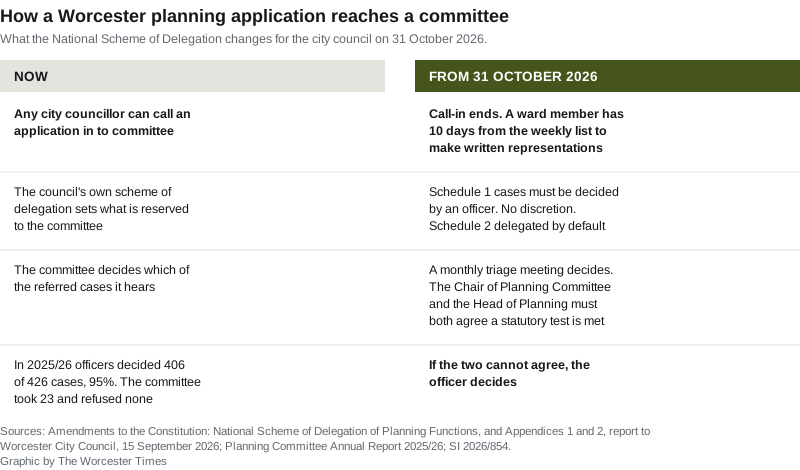
Worcester’s Planning Committee considered 23 planning applications in its last full year, approved all 23 and refused none. The same report records the planning service issuing 426 decisions in 2025/26, of which 406 were made by officers under delegated powers. That is 95 per cent.
The figures are in the Planning Committee Annual Report 2025/26, which goes to full Council on Tuesday 15 September. (Planning Committee Annual Report 2025/26, Worcester City Council)
On the same agenda, councillors are asked to sign away part of what is left. Item 8 adopts the Government’s new National Scheme of Delegation, which takes effect on 31 October and removes a councillor’s automatic right to send an application to committee. (Amendments to the Constitution: National Scheme of Delegation of Planning Functions, report of the Monitoring Officer)
What the committee actually did
The committee met 11 times in 2025/26 and made four site visits. Of the 23 applications it considered:
- 2 were householder applications
- 8 were full, outline or permission in principle applications, between them proposing 19 new homes
- 13 were other consents, including adverts, listed building consent and variations
Fourteen of the 23 were at committee for one reason only: the council or a councillor was the applicant, or the land belonged to the council.
Officers, meanwhile, refused 62 applications. Adding up the annual report’s own performance tables for 2025/26 gives 29 refusals among minor applications, 16 among householder applications and 17 among the “other” category. The committee refused nothing.
The service received 411 applications in the year, 18 were withdrawn, and 426 decisions were issued. The delegation rate rose from 93 per cent in 2024/25 to 95 per cent. An extension of time was agreed with the applicant in 38 per cent of cases, down from 40 per cent.
Two other numbers stand out. Just under half of householder applications, 48 per cent, were decided within six weeks of validation, up from 40 per cent the year before. And 27 appeal decisions came back, of which 9 were allowed. The report names two of the allowed appeals: the drive-thru restaurant at Elgar Retail Park on Blackpole Road, refused on highway safety grounds, and up to 28 affordable homes on land off Darwin Avenue.
On the Government’s measure for appeals against major applications, the council’s performance “remains slightly above the current threshold for designation”. The report asks for that to be read with caution. Worcester decided only four major applications all year, so one appeal can move the measure.
What changes on 31 October
The new rules come from the Town and Country Planning (Discharge of Local Planning Authority Functions) (England) Regulations 2026. (SI 2026/854, legislation.gov.uk) They sort every application into two groups.
Schedule 1 applications must be decided by an officer. There is no discretion. That group covers householder work, minor commercial schemes and residential schemes of one to nine homes on sites under half a hectare, along with lawful development certificates, prior approvals and non-material amendments.
Schedule 2 applications go to an officer by default. They reach the committee only if a nominated member and a nominated officer both agree that one of two tests is met. The report sets them out:
- the application “raises an economic, social or environmental issue of significance to the local area”
- the application “raises a significant planning matter having regard to the development plan and any other material considerations”
If the two cannot agree, the application is decided by officers. For Worcester the nominated member is the Chair of the Planning Committee and the nominated officer is the Head of Planning and Economic Development, currently Duncan Rudge. The Vice Chair and the Service Manager for Development Management stand in when either is unavailable.
Applications made by the council, a councillor or an officer still go to committee. That is written into the new Annex A of the constitution, and on last year’s figures it is the single biggest source of the committee’s workload. (Appendix 2: Changes to the Constitution)
Worcester’s committee had 11 members last year. The Regulations cap a determining committee at 13, so no reduction is needed here.
The monthly triage meeting
The part of Tuesday’s decision that residents will actually run into is Appendix 1, the council’s proposed local triage arrangements. It is new, and it sets the clock. (Appendix 1: Proposed Local Triage Arrangements)
The process runs like this:
- The Service Manager for Development Management reviews the weekly list and pulls out the Schedule 2 applications.
- That triage list goes to the Chair of the Planning Committee and the Head of Planning.
- Within 14 days of an application being made valid, cases are picked out for the triage meeting.
- Ward members are told about applications in their ward. If they think one should go to committee they must make written representations, against the two tests above, within 10 days of the weekly list being published.
- The triage meeting is normally held in the last week of each month, with a legal officer present and minutes taken.
- The two decide one of three things: report it to committee, decide it under delegated powers, or hold it over for more information.
Every referral decision has to be recorded with reasons tied back to the Regulations.
What it means for you
If you object to a neighbour’s extension or a small housing scheme, the committee is no longer an option at all from 31 October. Those are Schedule 1 applications and an officer will decide them. Your comments on the application itself still count, and they are still the thing an officer has to consider.
For anything larger, the only route to a public committee now runs through your ward councillor, and it is a short one. The ward member has 10 days from the weekly list, and has to argue the statutory tests rather than simply ask. If you want a scheme debated in public, contact your councillor in the week the application appears, not a month later.
You can still speak at Tuesday’s meeting itself. Full Council allows up to 15 minutes of public participation in total, with five minutes per speaker, on any item on the agenda or any matter within the council’s remit. The meeting starts at 7pm at the Guildhall on the High Street. (Agenda for Council, 15 September 2026, Worcester City Council)
Our Worcester planning news page tracks the applications and decisions as they land.
The committee said so itself
The Planning Committee looked at the same Regulations on 13 August. The Monitoring Officer’s report records that members “noted their disappointment about the restriction on a number of matters coming to locally elected representatives through the Planning Committee”. Officers replied that the restrictions come from the legislation, and suggested reviewing the scheme after a year. That review is the third recommendation on Tuesday.
The council has no real choice on the principle. The report warns that if the Regulations are not implemented, Planning Committee decisions “will be unlawful and subject to challenge including Judicial Review”.
There is a shorter clock behind all of this. Worcester City Council is abolished on 1 April 2028 and merges with Malvern Hills and Wychavon into a South Worcestershire unitary. The Monitoring Officer’s report notes that each successor authority will have to comply with the same Regulations, and that the work is expected to sit with the reorganisation planning group.
Update, 17 September 2026: this article describes Worcestershire’s reorganisation as decided in July 2026. On 7 September the government paused those decisions while it reviews the programme, and said May 2027 elections will go ahead to existing council boundaries. The 1 April 2028 date is now under review. Our report has the detail.
Have your say